Dear AAEP Colleagues,
I hope you are well & the end of the semester is going smoothly & you have exciting plans for the Summer ahead!
You will recall that I wrote to you all last year before Thanksgiving about our shared work in the arts in light of our moment of global mourning, for those killed & kidnapped in the horrific Hamas attacks in Israel, as well as the immense scale of ongoing violence against Palestinians in Gaza & the West Bank. I identified three questions around issues of censorship & arts institutions, how to do our work in a moment of crisis, & ways of gathering & sharing as a community, which I asked for your feedback on. While I only received one reply – which was really helpful & initiated an important dialogue between me & that colleague that wouldn’t have occurred without my email – I wanted to write to you again, this time with a more concrete proposal.
I am looking to submit a paper for the special theme issue of the Art Education journal ‘Calling for Critical Peace Amid War Crisis: Humanizing, Affective Art Educational Praxis’ (due date May 10) & I wanted to write something about the role of the visual arts in Palestinian solidarity movements here in the Basque Country that reflects on the role of the arts, as well as arts institutions & organizations, play in promoting anti-war and peaceful solutions to moments of ongoing violence, as is happening now in Israel-Palestine.
I have three options for my paper, each of them focused on the painting one side of this (virtual) postcard I’m sending you.
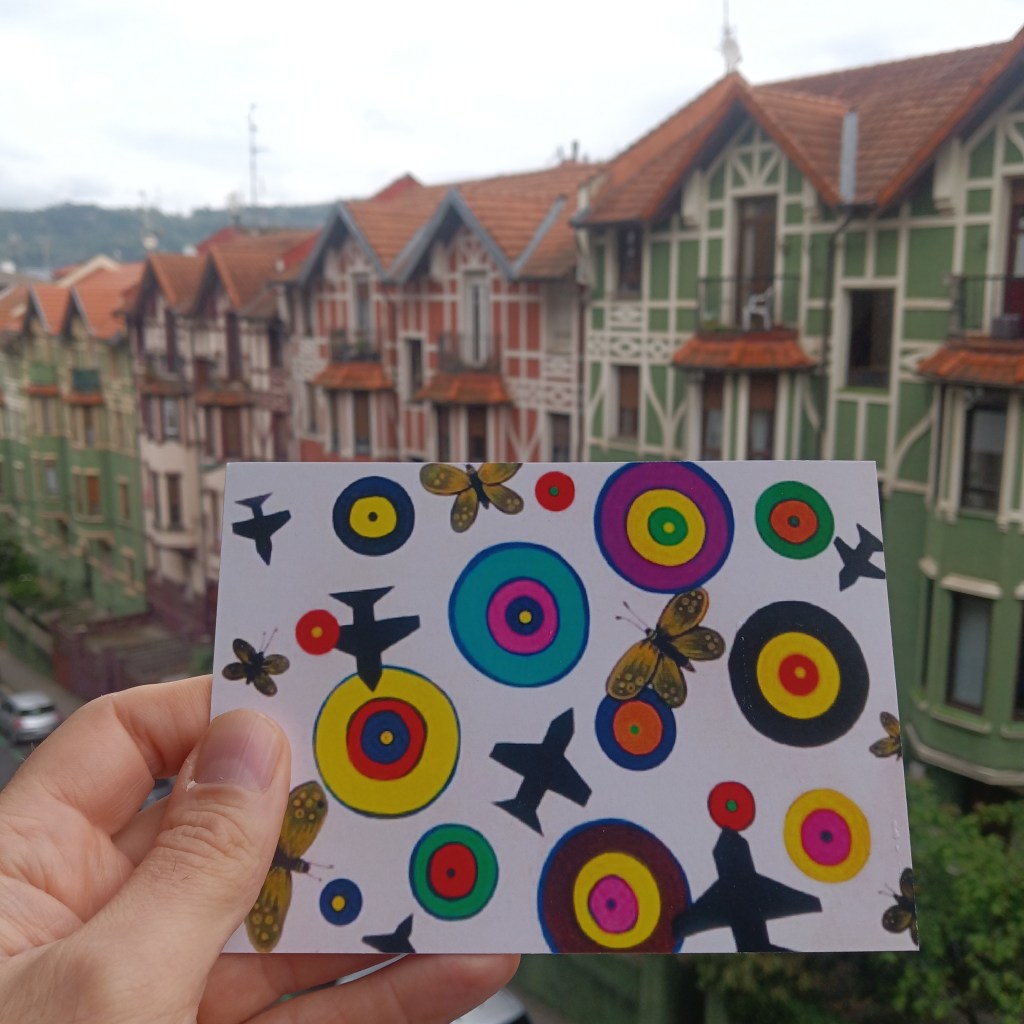
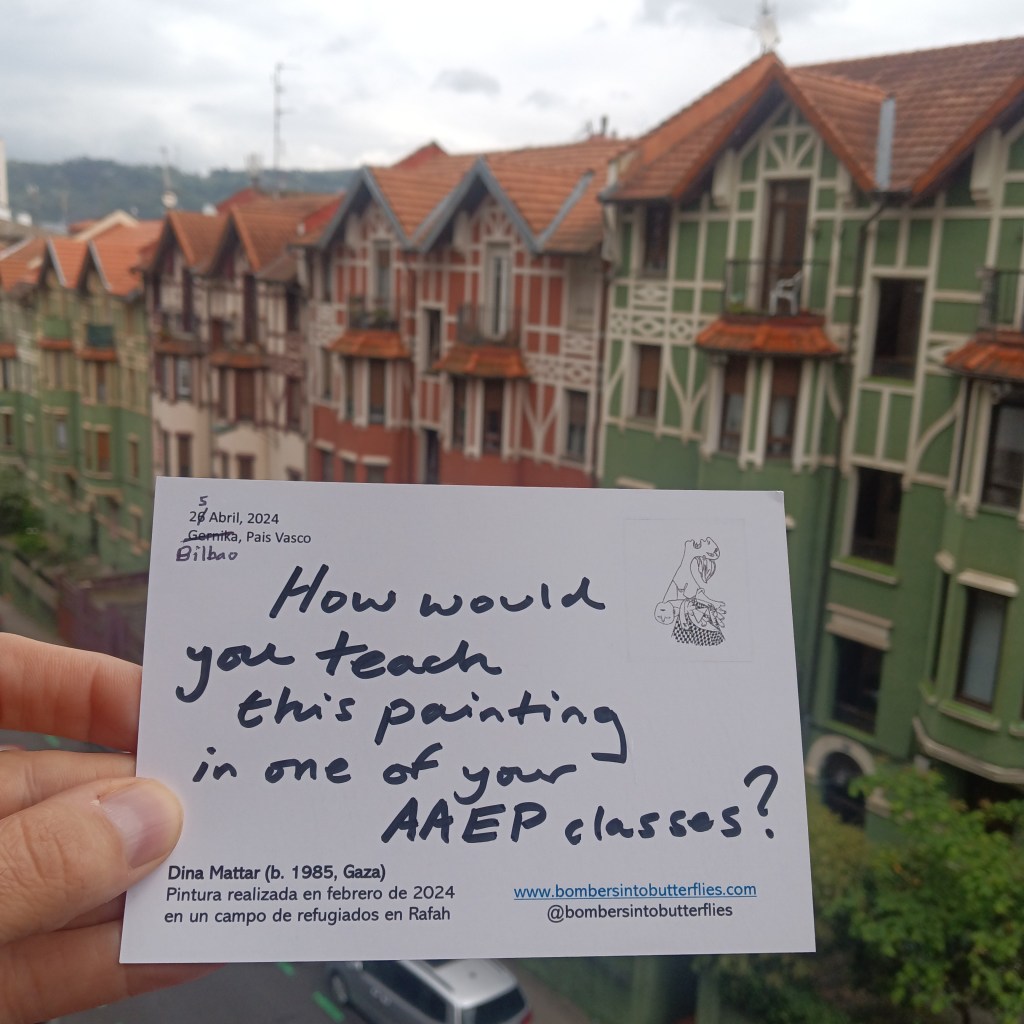
While on the other side is a question:
How would you teach this painting in one of your AAEP classes?
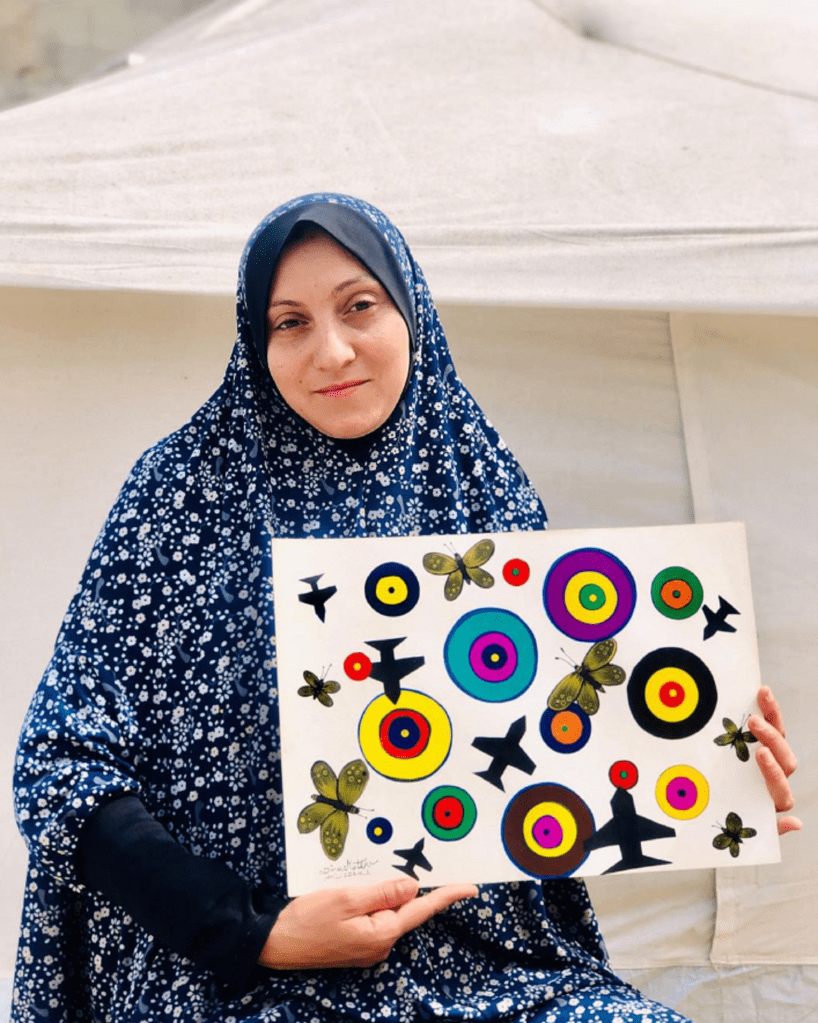
First some context. This is a recent painting (made in February this year) by the Gazan artist Dina Mattar while her & her family have been living in a refugee camp in Rafah. Here is a photo of her holding her new painting, posted on Instagram on March 17.
I have been in direct contact with Mattar, & her husband Mohammed Al-Hawajiri, who is also an artist, & she has given me permission to use this detail of her new painting as a way of bringing attention to her & her family’s desperate situation & that of an estimated 1.5 million people currently sheltering in Rafah, with news of an impending Israeli military operation.
I have created a new website – www.bombersintobutterflies.com & Instagram account @bombersintobutterflies, where I will document the ways in which share Mattar’s painting & story with the world.
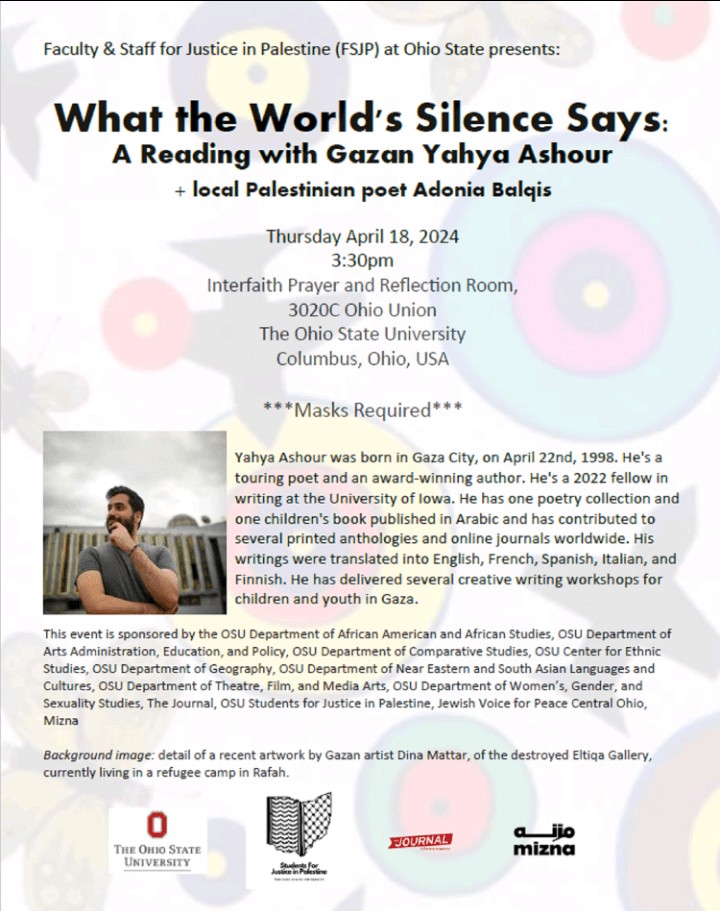
In fact, I have already used the painting in the poster for the recent visit of Gazan poet Yahya Ashour to OSU on April 18, which the department generously co-sponsored.
And I have now made physical postcards of the painting, one of which I am (virtually!) sharing with you here, & others I will be using in two actions here in the Basque Country, in Gernika & Vitoria, over the next two days (more details of which below).
(Like any postcard, which unlike a letter, is open to anyone who holds it to read, this message is also an open letter, & is posted on the website).
Now, back to the question: How would you teach this painting in one of your classes? Of course, you our department of Arts Administration, Education, & Policy at OSU teaches a broad range of classes & you all have different research areas & interests that go into what you teach for the department. So how you would teach the painting in a class would very much depend on the topic & your unique approaches. For example, I could imagine that for an arts management or arts entrepreneurship class, the context of Mattar’s work with the Eltiqa Gallery (destroyed in an Israeli airstrike in December last year) & the gallery’s history as explored by the collective The Question of Funding at the Lumbung One, aka documenta fifteen, exhibition in 2022. Or a museum education class could approach the painting in terms of the current exhibition ‘This is Not an Exhibition’ at the Palestine Museum or the way in which learning programs could address it within a museum collection where it may eventually end up. Or a class on social justice & art education could approach the painting in terms of traditions of anti-war activism & civil rights of marginalized groups, offering an international approach to US-based movements.
There are many possibilities grounded in the work we all do, & if you would be willing to share any reflections you have, no matter how brief or rough, perhaps together we could build an article that offers a portrait of the vital work we do as a department through our differing approaches to the painting?
Of course, this may not be possible for you at this time, in which case I would then move to my two other ideas for the article, each involving a different context for the painting on the postcard.
One is based on bringing the postcard to tomorrow’s (April 26) commemorations of the bombing of the small Basque town of Gernika & sharing it with participants in solidarity protests for Gaza, specifically within the context of the Gernika Peace Museum. Picasso’s Guernica has had such a powerful influence on how anti-war movements have been taught by art educators, that I would ground Mattar’s work in other Palestinian artists’ responses to Picasso’s painting & uses of it in past & current actions of solidarity in the Basque Country. The other option is to bring the postcard to the Artium museum in Vitoria on Saturday April 27, which is the last day of a very short solidarity exhibition of the British-Palestinian artist Rosalind Nashashibi & the film collective Subversive Film, who also participated in Lumbung One/documenta fifteen, with their archive Palestinian film project Tokyo Reels.
Whichever option I choose, I am writing this postcard to you all – as with any postcard sent home from abroad – to tell you I am thinking of you even though I am far away & that our shared work & the potential for collaboration, is important to me as we negotiate these truly challenging times, both in the shared work we do in the arts & in our lives as human beings, with our own distinct positionalities & approaches.
As of this morning, Thursday April 25, you may be able to look out of the department windows to the new student-led encampment for Gaza on the South Oval. I wish I could be there with you, but instead I am here, glued to my Instagram feed, waiting for updates of our local role in the national solidarity movement across US university campuses, as well as news from Gaza & the West Bank.
Do send word when you can & thank you for reading & wishing you all a restful break at the end of the semester.
All my best wishes,
Richard
 Bombers into Butterflies
Leave a comment